VI. Everything Converged in 2026
Three independent infrastructure shifts reached production maturity inside the same operating window. SWIFT pushed ISO 20022 across cross border payment traffic; FedNow compressed domestic confirmation latency; Oracle exposed live ERP state to programmatic workflow. By Q1 2026, data, confirmation, and execution could finally interact inside one control loop. Continuous receivables verification became technically executable for the first time.
The problem became urgent at the same moment the solution became operational.
Sources: SWIFT, Federal Reserve, Oracle.
Pipe 1: ISO 20022. The data layer.
Structured remittance became evidence.
By late 2025, SWIFT reported 97 percent of cross border payment instructions in ISO 20022 format. Payment messages now carry structured invoice references, amounts, dates, purchase order fields, and adjustment data in machine readable form. That changes the verification surface. Payment traffic can be reconciled against the commercial event that generated it, rather than treated as a post settlement cash record. The payment message is now part of the evidence chain.
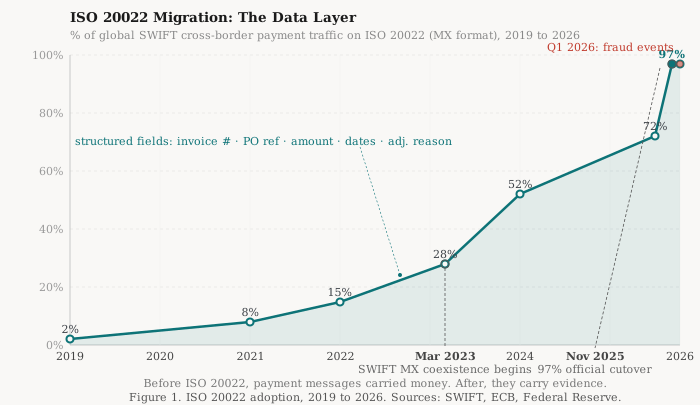
Structured remittance does not prevent fraud by itself. It makes reconciliation precise enough for software to participate.
Sources: SWIFT, ECB, major bank implementation updates.
Pipe 2: FedNow. The speed layer.
Confirmation moved to operational time.
FedNow launched with 35 institutions in July 2023 and passed 1,500 participants by late 2025. Over the same period, the network limit moved from $500,000 to $10 million. The strategic point is latency. Confirmation that once arrived through day, week, or month end processes can now arrive fast enough to update payment state during the life of the asset. Batch confirmation became operational confirmation. That collapsed the time gap exploited by duplicate pledge and cash diversion schemes.
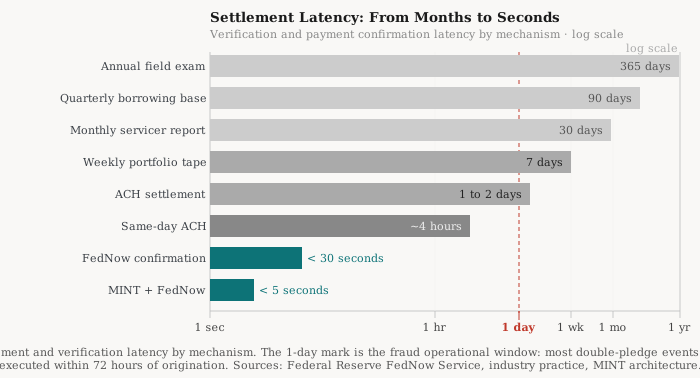
A confirmation signal that arrives after the control cycle is a report. A confirmation signal inside the asset life is a control input.
Sources: Federal Reserve, FRB Services.
Pipe 3: Oracle Agentic ERP. The execution layer.
ERP became a live verification surface.
Oracle used 2025 and 2026 to make the shift explicit. More than 600 embedded agents and assistants were announced across Fusion Cloud and industry applications, followed by 22 Fusion Agentic Applications and new agentic tooling in March 2026. The important shift is architectural. ERP no longer sits at the end of the process as a quarterly reporting source. It can expose approval state, goods receipt, dispute signals, ledger entries, and workflow status inside active transactions. Execution moved into the ledger environment itself.
Business systems can now return live state instead of exported files.
Sources: Oracle AI World announcements, Oracle product releases.
The closed loop.
Creation, pledge, payment, and confirmation can now reconcile continuously.
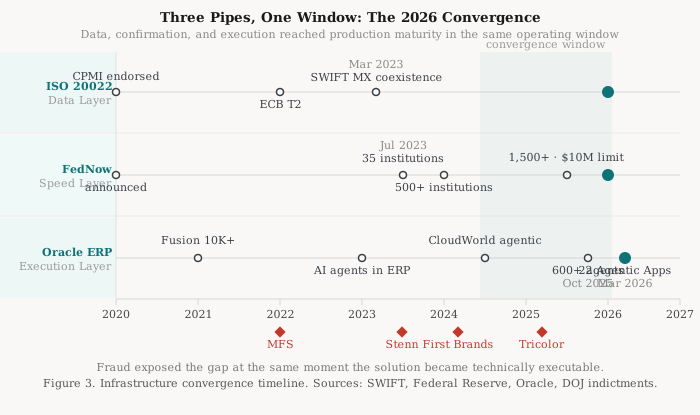
The commercial event creates structured state. The payment rail returns structured confirmation. The ERP system records each transition as it occurs. The verification layer can test the asset before purchase and keep testing it through collection. The phases no longer have to be separated by batch delay and manual review. The control loop can run inside the life of the asset.
Sources: SWIFT, Federal Reserve, Oracle, MINT synthesis.